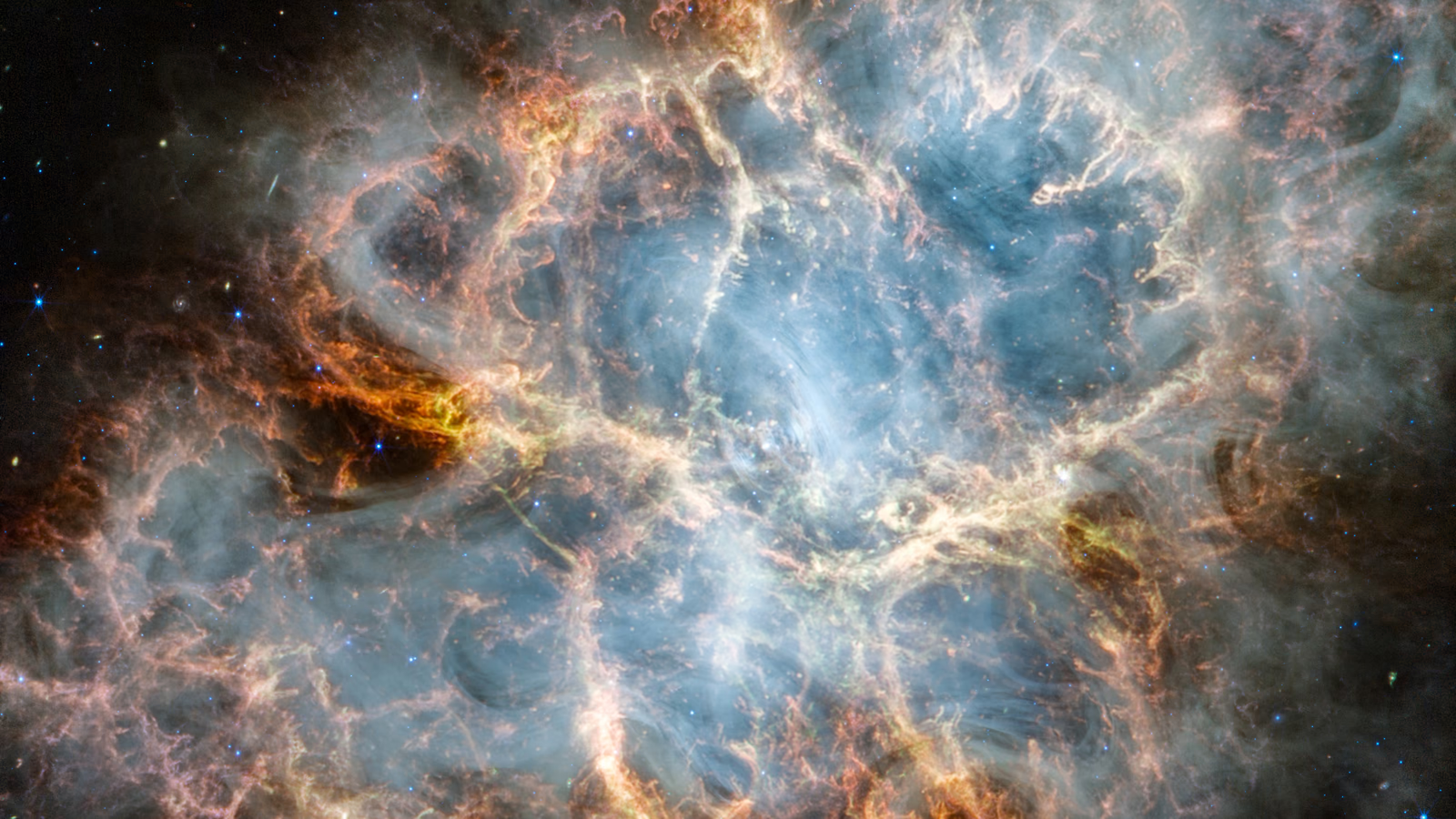
In the personal universe of this page, the astronomy nebula is the Crab, and at its centre there is an object I find more fascinating than any nebula: a pulsar.
What it is
When a very massive star runs out of fuel, its core collapses and the outer layers are blown off in a supernova. What remains is a neutron star: one and a half solar masses squeezed into a sphere about twenty kilometres across. Collapsing, it conserves angular momentum, so it spins extremely fast, and it conserves its magnetic field, so it emits beams of radiation from the magnetic poles. If the spin axis and the magnetic axis do not coincide, the beam sweeps the sky like a lighthouse. Every time it points at Earth, we see a pulse. That is a pulsar.
The one in the Crab, the remnant of the supernova Chinese astronomers recorded in 1054, spins 30 times per second. Millisecond pulsars spin more than 700 times per second: a sphere the size of a city turning seven hundred times while you read this sentence.
An accidental discovery
In 1967 Jocelyn Bell Burnell, a doctoral student at Cambridge, was analysing kilometres of radio-telescope chart paper and noticed a “bit of scruff”: a periodic signal every 1.337 seconds, too regular to be natural. The lab joke was to call it LGM-1, for “little green men”. It was the first pulsar. The 1974 Nobel Prize for the discovery went to her supervisor, not to her, an injustice the astronomical community itself acknowledged decades later.
Cosmic clocks
What makes pulsars special is regularity: some millisecond pulsars are so stable they rival atomic clocks over years. With that precision, general relativity has been tested in binary systems, gravitational waves were detected indirectly before LIGO measured them directly, and today arrays of pulsars scattered across the galaxy work as a gravitational-wave detector the size of the Milky Way.
Why it matters to someone in data
A pulsar is an almost perfect time series with noise, slow drift and occasional frequency glitches. Analysing it is exactly what statistics teaches: model the trend, separate signal from noise, detect regime changes. That the signal comes from a dead star thousands of light-years away only makes it more exciting.